
Radar-Based Lane Keeping System — Reliable Guidance at Any Speed
Lane Precision
Max Speed
Radar Frequency
Road Infrastructure
Our Solution — Trihedral Corner Cube Radar Reflectors
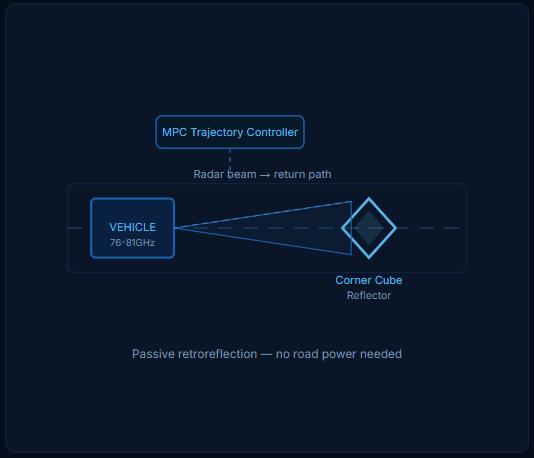
How Corner Cube Reflectors Work
Camera-based lane detection fails in fog, rain, snow, and at night. Painted lane markings fade, wash away, and disappear under snow. The autonomous vehicle industry has known this for years — but has no solution that works at highway scale.
Sudarshan’s solution uses the unique physics of trihedral corner cube retroreflectors. A trihedral corner cube — three mutually perpendicular reflective surfaces meeting at a point — returns radar energy back along exactly the incident path, regardless of angle of incidence.
Radar Signal Processing and Waypoint Generation
The vehicle’s onboard radar unit detects the reflected signal from roadside reflectors, computes precise lateral position relative to the lane centerline, and feeds this data into the Model Predictive Control for Trajectory Tracking algorithm.
- ±5–10mm lane precision at 130 km/h
- 76–81 GHz standard automotive radar frequency
- No powered roadside infrastructure required
- Retrofit deployment on existing highway infrastructure
- SAE Level 4 lane keeping capability
All-Weather Performance — Rain, Fog and Low Visibility
Unlike cameras and lidar, radar penetrates fog, heavy rain, and snow. Corner cube reflectors maintain their retroreflective property in all conditions. The system has been validated in simulation across the full range of adverse weather conditions relevant to USA and India highway environments.
IMU Integration — Bridging Radar Gaps
In sections without reflectors, the system seamlessly transitions to IMU-based dead reckoning. The Inertial Measurement Unit maintains lane position accuracy during the brief interval between reflector detections — typically 10–50 meters. Supports integration with elastic platooning and highway automation solutions.
Patented Architecture and System Reliability
The full system architecture — reflector geometry, radar processing pipeline, MPC controller, and IMU fusion layer — is protected by Sudarshan's IP portfolio. Validation results and simulation data are available for government and fleet partner review.
Applications — Highways, Platoons and Automated Corridors
Deployed as the foundational layer of the HEART system, the radar lane keeping system supports highway automation solutions, elastic platooning, and automated corridor management for government and commercial operators.